
Political Mobile Billboards for the 2026 General Election: Disclaimer Rules, Early-Voting Dates and Route Strategy
- Early voting is the real peak: Georgia advance voting runs Oct. 13–30 with mandatory Saturdays Oct. 17 and 24; Florida’s mandatory window is Oct. 24–31.
- Federal rules require the disclaimer in a printed box, readable and high-contrast. The 12-point safe harbor only covers signs up to 24 by 36 inches, so a truck panel needs far larger text.
- Florida and Georgia both bar solicitation within 150 feet of polling places. Route the truck around those zones, never into them.
- LED trucks let you change the message daily during early voting, from “Early voting starts today” to “Last day to vote early.”
- Mobile Billboard Global political campaigns start at about $150 per hour. A standard 8-hour LED day runs about $1,400.
The 2026 general election calendar: when voters actually decide
Your truck should peak during early voting, not just on Election Day. In Georgia and Florida, early voting turns Election Day into an election month. Every day a voter passes your message before casting a ballot is a day that counts.
| Date (2026) | Georgia | Florida |
|---|---|---|
| Oct. 5 | Voter registration deadline | Voter registration deadline |
| Oct. 13–30 | Advance (early) voting. Starts Tuesday because Monday, Oct. 12 is a state holiday. | — |
| Oct. 17 & Oct. 24 | Mandatory statewide Saturday voting | — |
| Oct. 22, 5 p.m. | — | Deadline to request a mailed vote-by-mail ballot |
| Oct. 23 | Last day to request an absentee ballot | — |
| Oct. 24–31 | — | Mandatory early-voting period (counties may add days) |
| Nov. 3 | Election Day | Election Day (includes a U.S. Senate special election) |
| Dec. 1 | Runoff for races where no one tops 50% | — |
Counties set their own early-voting sites and hours. Check the county election office before you lock a route. In Georgia, some counties also open on Sundays. Running metro Atlanta routes? See our Atlanta mobile billboard guide.
Why mobile billboards fit the final 30 days
A truck goes where voters are this week. A fixed billboard stays where it was booked a month ago. That flexibility matters most in the closing stretch.
- Follow early-voting traffic. Loop the roads leading to county voting sites (outside the legal buffer zones covered below).
- Change the message overnight. LED screens take new files the same day. Run “Early voting starts Tuesday” on Monday and “Polls close at 7 p.m.” on Election Day.
- Stay inside the district. Routes follow precinct and district lines. A highway billboard reaches whoever drives past, voter or not.
- Show up at the moment. Rallies, debates, homecoming games and town halls draw exactly the people you want.
- Prove where you ran. A route report shows the streets and hours covered, which helps with committee reporting and post-campaign review.
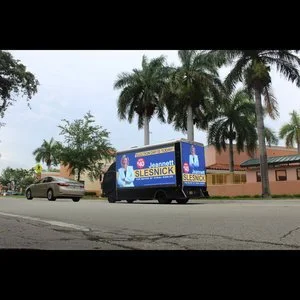
For a deeper look at how campaigns use trucks across a full cycle, see our political mobile billboard advertising page and our earlier guide to reaching battleground voters in the 2026 primaries.
Disclaimer rules: what must appear on the truck
Nearly every paid political message on a truck needs a “paid for by” disclaimer. The exact wording depends on who paid, whether the candidate authorized it and which race it covers. Have your treasurer or campaign counsel sign off on the final wording before we load any file.
Federal races (U.S. House and Senate)
The Federal Election Commission rule is 11 CFR 110.11. It covers public communications, which include outdoor advertising.
- Paid by the candidate’s committee: “Paid for by [committee name].”
- Authorized by the candidate, paid by someone else: “Paid for by [payer] and authorized by [candidate or committee].”
- Not authorized by any candidate: “Paid for by [payer] and not authorized by any candidate or candidate’s committee,” plus the payer’s street address, phone number or website.
Format rules apply to printed communications:
- The disclaimer must sit in a printed box set apart from the rest of the ad.
- It must be clearly readable. Twelve-point type is a safe harbor only for signs up to 24 by 36 inches. A truck panel is many times that size, so the type must scale up.
- It needs reasonable color contrast. Black text on a white box always satisfies the rule.
Digital screens are not exempt. In MUR 7355, the FEC’s general counsel treated an electronic billboard as a public communication that required a disclaimer.
Florida
Florida Statute 106.143 governs state and local races. Florida’s Division of Elections summarizes the rules this way:
- Paid for by the candidate: “Political advertisement paid for and approved by [name], [party affiliation], for [office]” or the short form “Paid by [name], [party], for [office].”
- Paid by anyone else on the candidate’s behalf: the candidate must approve it in advance, and the ad must say so and state who paid.
- Partisan races: include the party name, or state that the candidate has no party affiliation.
- Other languages: an ad in Spanish or Haitian Creole may carry the disclaimer in that same language.
Georgia and other states
State rules vary, and some set a minimum size:
- Arizona (A.R.S. 16-925): on a sign or billboard, the disclaimer must be at least 4% of the sign’s height, or 10% if a PAC paid.
- New York (Election Law 14-106): “Paid for by [committee name].”
- North Carolina (G.S. 163-278.39): “Paid for by [sponsor].”
- Georgia: federal races follow the FEC. For state and local races, confirm current wording with the Georgia State Ethics Commission before printing.
How big should the disclaimer be on a truck?
Use 4% of the panel height as your floor, even where the law sets no number. Arizona’s billboard rule is a practical benchmark for text people can read from a moving car.
| Truck panel | Panel height | Minimum letter height at 4% |
|---|---|---|
| LED side screen (7 ft × 14 ft) | 84 in | About 3.4 in |
| LED rear screen (7 ft × 7 ft) | 84 in | About 3.4 in |
| Static side banner (10 ft × 22 ft) | 120 in | About 4.8 in |
| Static rear banner (3 ft × 10 ft) | 36 in | About 1.4 in |
On LED trucks, put the boxed disclaimer on every frame in the rotation, in the same corner each time. A viewer may only see one frame.
Polling-place buffer zones: where the truck cannot stop
Never park or idle a campaign truck inside a polling-place buffer zone. Both of our core Southeast states set one:
- Florida (s. 102.031): no soliciting voters within 150 feet of the entrance to a polling place or early-voting site.
- Georgia (O.C.G.A. 21-2-414): no campaigning within 150 feet of the outer edge of a building used as a polling place, inside the polling place, or within 25 feet of any voter standing in line.
Our drivers keep campaign trucks moving on surrounding roads and plan turnarounds well outside these zones. Other states have their own distances, so we check each jurisdiction before routing. Our mobile billboard laws guide covers city rules that apply year-round.
Where to route a political truck
| Route type | Why it works | Timing tip |
|---|---|---|
| Roads leading to early-voting sites | Reaches voters on the way to vote | Weekday lunch and after 4 p.m.; stay outside the 150-ft zone |
| Commuter corridors inside the district | High repeat exposure to the same residents | 7–9 a.m. and 4–7 p.m. |
| Saturday shopping and market districts | Matches Georgia’s mandatory Saturday voting (Oct. 17 and 24) | 10 a.m.–4 p.m. |
| Campuses and student neighborhoods | Get-out-the-vote reminders for younger voters | Class-change times, game days |
| Rallies, debates and town halls | Supporters and media in one place | Arrive 60–90 minutes before start |
| Faith and community corridors | Sunday voting where counties offer it | After services, where permitted |
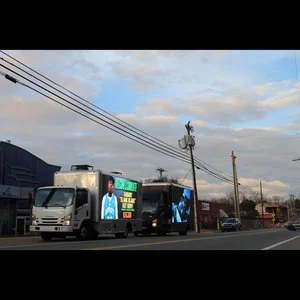
Creative that works at road speed
Keep the main message to about seven words. Drivers glance for a few seconds. Build each frame around four parts:
- The candidate or issue name, as large as the panel allows.
- The office or ballot measure.
- One dated action: “Vote early Oct. 13–30” or “Vote Nov. 3.”
- The boxed disclaimer.
On LED trucks, add a countdown frame you update daily, and build Spanish or Haitian Creole versions for South Florida routes. Save QR codes for slow-moving or parked moments, such as rally arrivals, where people can actually scan. Our LED vs. static truck guide has screen sizes and design rules.
Budget and booking timeline
Mobile Billboard Global political campaigns start at about $150 per hour. A standard 8-hour LED truck day runs about $1,400. Final pricing depends on market, dates, hours and truck count. A five-day get-out-the-vote push with one LED truck runs about $7,000 at the standard day rate, before any multi-day pricing.
- Book now. The last 10 days before Nov. 3 are the most requested dates of the year.
- LED files: send final JPEG or MP4 files 4–8 hours before the start time so we can check formatting.
- Static banners: allow extra days for printing and installation.
See our 2026 mobile billboard cost guide for how hours, trucks and markets change the price.
Political mobile billboard checklist
- Confirm the sponsor and exact disclaimer wording with your treasurer or counsel.
- Map early-voting sites and mark the buffer zone around each one.
- Choose LED (daily message changes) or static (one strong message, lower cost).
- Build frames: name, office, dated action, boxed disclaimer on every frame.
- Lock dates. Prioritize early-voting Saturdays and the final five days.
- Send LED files 4–8 hours before launch, or approve the static proof early.
- Collect the route report after each day for your records.
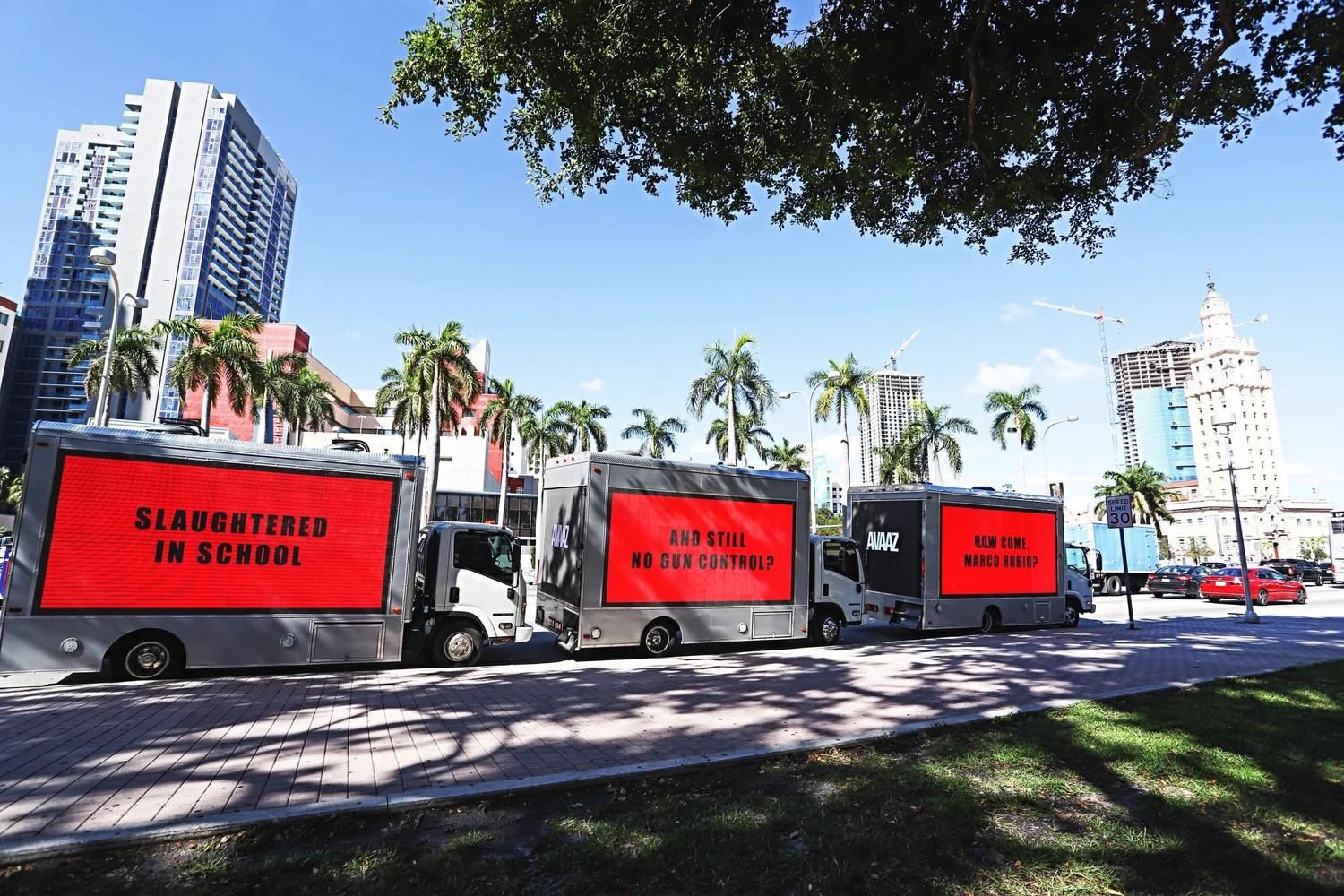
Ready to plan? Visit our November elections page or browse the campaign gallery.
Frequently asked questions
Do political mobile billboards need a “paid for by” disclaimer?
Yes, in nearly all cases. Federal rules (11 CFR 110.11) require a boxed, readable, high-contrast disclaimer on outdoor political ads. Most states, including Florida, require similar wording for state and local races. Confirm exact wording with your treasurer or counsel.
Can a campaign billboard truck park outside an early-voting site?
Not inside the buffer zone. Florida bars solicitation within 150 feet of a polling place or early-voting site entrance. Georgia bars it within 150 feet of the polling-place building and within 25 feet of voters in line. Keep the truck moving on surrounding roads instead.
How much does a political mobile billboard cost?
Mobile Billboard Global political campaigns start at about $150 per hour, and a standard 8-hour LED truck day runs about $1,400. Price depends on market, dates, hours and the number of trucks.
How far ahead should we book for the November 3, 2026 election?
Book as early as possible. The final 10 days before Election Day are the most requested dates of the year. LED artwork is due 4 to 8 hours before start time; static banners need extra days for printing.
Do disclaimer rules apply to LED screens?
Treat them as if they do. In MUR 7355 the FEC general counsel treated an electronic billboard as a public communication requiring a disclaimer. Put the boxed disclaimer on every frame in your rotation.
Can we change the message during early voting?
Yes, on LED trucks. Send a new JPEG or MP4 file and it can run the same day, so you can move from “Early voting starts today” to “Last day to vote early” as the calendar changes.
About the author: Steven B. is the founder and CEO of Mobile Billboard Global, an Atlanta-headquartered mobile billboard company with 15 years in business, 178 billboard units and more than 34,000 campaign hours completed across U.S. markets. Questions? Call (404) 382-9805 or email Booking@mobilebillboardglobal.com.
Sources
- FEC: Advertising and disclaimers
- 11 CFR 110.11, Communications; advertising; disclaimers
- FEC MUR 7355, First General Counsel’s Report (electronic billboard)
- Florida Division of Elections: Campaign Advertising FAQ
- Florida Division of Elections: 2026 Election Dates
- Florida Statutes s. 102.031 (polling-place solicitation)
- Georgia.gov: First Saturday for early voting, 2026 general election
- Arizona Revised Statutes 16-925
- New York State Board of Elections: political advertisement disclosures
- North Carolina State Board of Elections: Disclosure legends
This article is general information, not legal advice. Laws and ordinances change; confirm current rules with the relevant election office, city or your attorney before you run a campaign.