
- No single federal law bans mobile billboards. Rules come from state vehicle codes and local sign and parking ordinances.
- The key legal line is moving vs. parked. Most bans target vehicles parked to act as signs.
- Miami-Dade bans vehicles parked continuously as advertising signs; Miami Beach bars advertising vehicles on Ocean Drive and certain residential streets.
- California lets cities regulate non-motorized billboard displays; Los Angeles bans parking them on public streets.
- New York City is the strictest major market. Any NYC campaign needs a compliance plan before booking.
Last reviewed: October 2026. Codes change. This guide is general information, not legal advice.
Who regulates mobile billboards?
Three layers of rules apply, and the local layer decides most cases.
- Federal and state vehicle rules. Registration, insurance, lighting and commercial-vehicle standards apply to the truck itself. The federal Highway Beautification Act was written for fixed signs along major highways, not for trucks in traffic.
- State enabling laws. Some states spell out what cities may regulate. California is the clearest example (see below).
- City and county codes. Sign codes, parking limits, noise rules and street-specific bans. This is where most restrictions live.
Moving vs. parked: the distinction that matters most
A truck driving in normal traffic is usually treated as a vehicle. A truck parked to display an ad is often treated as a sign. That single difference explains most local rules:
- Codes commonly ban vehicles “parked continuously” or “used solely” as advertising signs.
- Non-motorized trailers carrying billboards draw the strictest rules, because they can be left on a street for days.
- Business vehicles in daily use with their own logo are usually exempt.
City-by-city rules
| Jurisdiction | What the code says | What it means for your campaign |
|---|---|---|
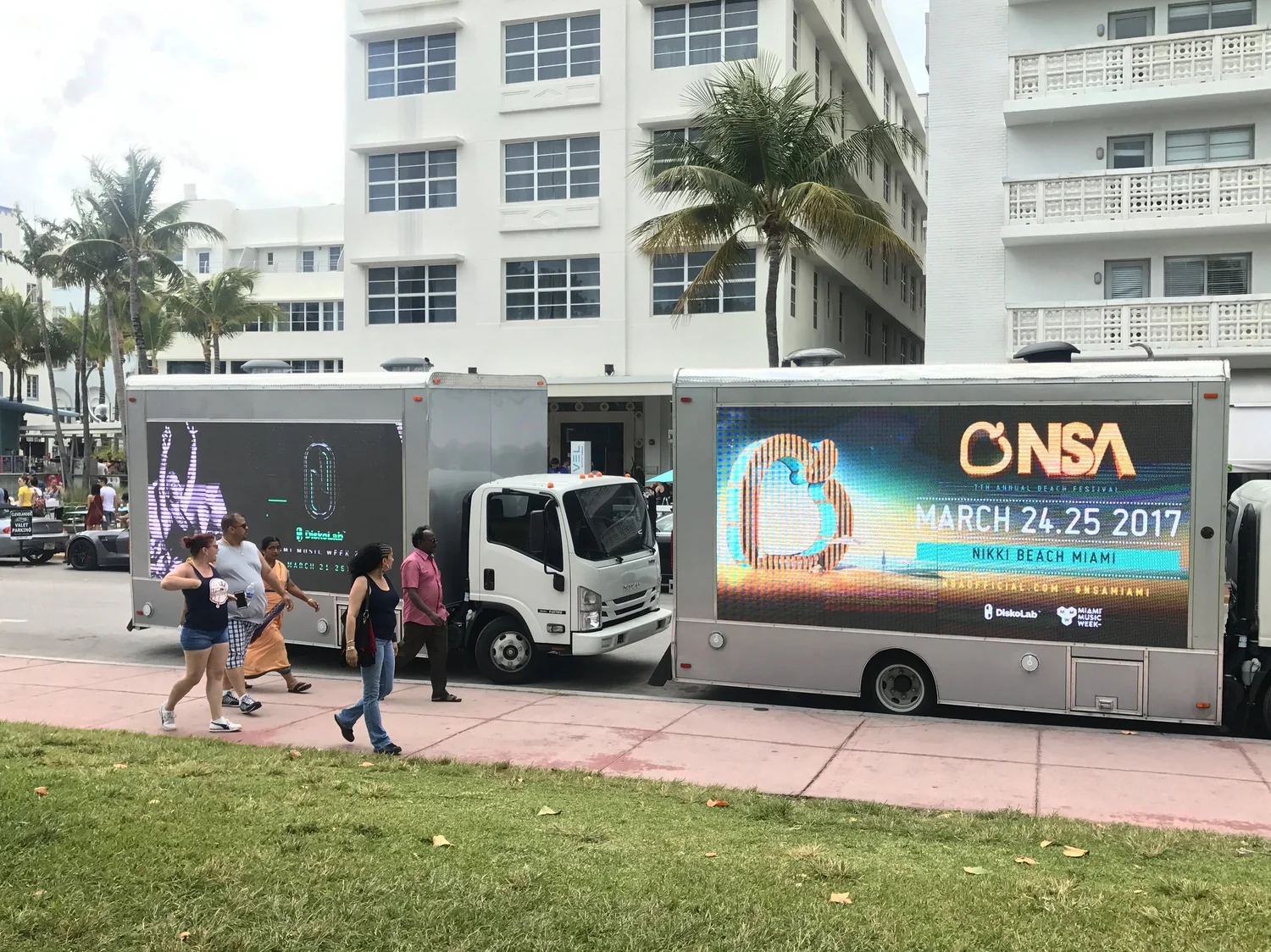
| Miami-Dade County, FL | Sec. 33-95 and Sec. 19-15.12: vehicles, vans, trailers or trucks may not be parked continuously in one location to be used solely as advertising signs. Business vehicles with logos in daily use are allowed. | Keep the truck moving. Do not stage it in a lot or on a street as a stand-alone sign. |
| Miami Beach, FL | Sec. 138-61: signs on parked vehicles are prohibited, with exemptions that include vehicles carrying candidate or ballot-measure signs. The section also makes it unlawful to operate an advertising vehicle on all of Ocean Drive and on residential streets under city jurisdiction. | Route around Ocean Drive and residential blocks. Plan on major commercial streets instead, and confirm the current code first. |
| Other Miami-Dade cities | Municipalities can be stricter. Miami Lakes Ord. 22-305, for example, prohibits signs on vehicles used to advertise a business as viewed from the road. | Check each city on the route, not just the county. |
| New York City | City traffic rules (34 RCNY 4-12) restrict operating, standing or parking a vehicle mainly for advertising. City Council bills in 2018, 2022 and 2024 described moving billboards as “already illegal” under those rules. Notices on vehicles in normal delivery or business use are allowed under conditions. | NYC needs a written compliance plan before booking. Ask any operator exactly how their trucks operate within these rules. |
| California / Los Angeles | Vehicle Code 395.5 defines a “mobile billboard advertising display” as a sign on a non-motorized vehicle, device or bicycle. Section 21100 lets cities regulate them. Los Angeles Municipal Code 87.53 makes it unlawful to park one on any public street, with removal after a warning. | Billboard trailers are the main target. Motorized LED trucks should keep moving and follow parking limits. |
| Austin, TX | Ordinance 20080605-076 (2008) amended city code 25-10 to prohibit mobile billboards, defined as signs on vehicles in the right-of-way advertising a business unrelated to the vehicle owner, with a narrow exception. | Check the current Austin code before planning any route there. |
| Atlanta, GA | We found no section in Atlanta’s Chapter 6 (Advertising) aimed specifically at mobile billboards. Chapter 6 covers fixed signs and billboards, and the city bans signs placed in the public right-of-way. | Standard traffic and parking rules apply. Parked activations need property-owner permission; big events can add temporary rules. See our Atlanta route guide. |
Running a campaign in our home market? Our Georgia mobile billboard page covers Atlanta-area routes, and our Florida page covers Miami, Fort Lauderdale and beyond.
Content rules that apply everywhere
- No look-alike traffic signals. Avoid red/green flashing patterns or graphics that mimic official signs.
- Design within the rules. Our LED vs. static design guide covers sizes and creative rules.
- Lawful content only. Obscene, false or defamatory ads create liability no matter how the truck is permitted.
- Political ads need disclaimers. See our 2026 political mobile billboard guide for federal and state wording.
- Audio is local. Exterior speakers are allowed only on approved campaigns and where noise rules permit. Beach towns such as Ocean City, Maryland enforce strict noise ordinances.
Parked activations and major-event zones
Plan any parked time as a separate permit question. A truck staged at a store opening on private property needs the owner’s written permission. Parking on a public street for display usually runs into the rules above.
Host cities for very large events, such as a Super Bowl or World Cup match, often create temporary “clean zones” that restrict commercial advertising near venues. Check event-specific rules early.
Compliance checklist for advertisers
- Confirm the operator’s commercial auto insurance and vehicle registration.
- Get the route in writing and check it against restricted streets.
- Agree that the truck keeps moving, with no long parked stops on public streets.
- Get written permission for any parked time on private property.
- Ask who pulls permits for stationary or special-event activations.
- Add required disclaimers to political or issue ads.
- Confirm audio is allowed on the route before turning on speakers.
- Keep the route report on file in case anyone questions where the truck ran. Here’s what a route report shows.
How we handle compliance
Mobile Billboard Global has run mobile campaigns for 15 years and more than 34,000 campaign hours. Every route is planned around local rules before the truck rolls: restricted streets, parking limits, event zones and audio rules. If a route won’t work legally, we’ll tell you before you book, and we’ll suggest the closest compliant alternative.
More questions? Visit our mobile billboard FAQ or what is mobile billboard advertising.
Frequently asked questions
Are mobile billboards legal?
Yes, in most U.S. cities. Local rules mainly target vehicles parked as stand-alone signs, non-motorized billboard trailers and specific streets. A few places, such as New York City and Austin, Texas, restrict them more broadly.
Do you need a permit for a mobile billboard?
Moving campaigns rarely need a special permit beyond normal commercial vehicle registration and insurance. Parked or stationary activations may need property-owner permission or a city permit.
Can a mobile billboard truck park on the street?
Often not as a display. Miami-Dade bans vehicles parked continuously as advertising signs, and Los Angeles bans parking non-motorized billboard displays on public streets. Plan the campaign as a moving route.
Are mobile billboards legal in New York City?
New York City is the most restrictive major market. City traffic rules (34 RCNY 4-12) restrict vehicles operated mainly for advertising. Any NYC campaign needs a compliance plan before booking.
Can a billboard truck play music or audio?
Only where local noise rules allow it and the campaign is approved for audio. Many cities and beach towns limit vehicle noise, so audio is planned route by route.
Where can't a mobile billboard drive in Miami Beach?
Miami Beach code Sec. 138-61 makes it unlawful to operate an advertising vehicle on all of Ocean Drive and on residential streets under city jurisdiction.
About the author: Steven B. is the founder and CEO of Mobile Billboard Global, an Atlanta-headquartered mobile billboard company with 15 years in business, 178 billboard units and more than 34,000 campaign hours completed across U.S. markets. Questions? Call (404) 382-9805 or email Booking@mobilebillboardglobal.com.
Sources
- Miami-Dade County: Sign regulations (Sec. 33-95, 19-15.12)
- Miami-Dade County: Prohibited advertising on commercial property
- City of Miami Beach Code Sec. 138-61 (PDF)
- Town of Miami Lakes Ordinance 22-305 (PDF)
- NYC Council Int 0541-2024, Banning moving billboards
- NYC Council Int 0075-2022, Banning moving billboards
- California Vehicle Code 21100
- Los Angeles Municipal Code Sec. 87.53
- City of Austin Ordinance 20080605-076
- Atlanta Code of Ordinances, Chapter 6: Advertising
This article is general information, not legal advice. Laws and ordinances change; confirm current rules with the relevant election office, city or your attorney before you run a campaign.