
Mobile Billboard Trucks in New York | 65,000 Impressions in 8 Hours
Mobile Billboard Trucks in New York: How an 8-Hour Route Delivers 65,000+ Impressions
A mobile billboard truck in New York delivers approximately 65,000 impressions over a single 8-hour route, at $150 to $200 per hour — roughly $1,200 to $1,500 for a full day. That works out to a CPM of about $18 to $23, against static Manhattan billboards that commonly run $5,000 to $25,000 or more for a four-week minimum. The 65,000 figure is not a marketing round number: it comes from GPS-logged routes, published DOT traffic counts on the corridors we run, and pedestrian volume on the blocks where the truck dwells. Below is the full math, a real New York campaign broken down block by block, current pricing, the NYC rules that actually apply, and how to route a truck so it reaches the people you need.
What's in this guide
- What is a mobile billboard truck?
- How 65,000 impressions in 8 hours is calculated
- Case study: a labor campaign in Hudson Square
- The best mobile billboard routes in New York
- What a mobile billboard truck costs in NYC
- Mobile billboards vs. static billboards vs. transit ads
- How to design creative that works at 25 mph
- NYC rules, permits and what's actually legal
- How to measure and report a campaign
- How to book a New York truck in five steps
- Frequently asked questions
1. What is a mobile billboard truck?
A mobile billboard truck is a box truck fitted with large-format advertising panels — either printed vinyl or a full-motion LED screen — that drives a pre-planned route and dwells in high-footfall locations. Instead of waiting for your audience to pass a fixed board, you bring the board to your audience.
In New York the format matters more than it does anywhere else in the country. Manhattan is the densest pedestrian environment in North America and its static billboard inventory is largely locked up on long-term contracts. A rooftop board reaches whoever happens to look up. A truck at street level — moving at traffic speed with roughly ten feet of illuminated creative on each flank — sits directly in the eyeline of every driver, every cyclist, every person waiting at a crosswalk, and every café table on the sidewalk.
Our New York fleet runs three configurations:
- LED digital trucks. Full-motion video on the side and rear panels, dayparted creative, content swapped remotely in minutes. This is the default New York unit and the one the $150–$200 hourly rate refers to. Best when you need multiple messages, motion, or a different message by neighborhood.
- Three-sided static trucks. Two large side panels plus a rear panel in printed vinyl, internally lit for evening runs. Best for a single message running multiple weeks, where the one-time print cost spreads across a long flight.
- Hybrid activation trucks. Billboard panels plus a street team, sampling setup or staging. Best for product launches, rallies, grand openings and press moments where you want people to stop rather than just look.
2. How 65,000 impressions in 8 hours is calculated
A New York route averages roughly 8,000 impressions per hour, and an 8-hour day lands at approximately 65,000. Here is the arithmetic, because you should never accept an impression number a vendor won't show their work on.
An impression in out-of-home is a likely-to-see exposure — a person positioned to view the panel. We build the estimate from three separate streams, then de-duplicate.
| Input | Typical Manhattan value | 8-hour contribution |
|---|---|---|
| Vehicle traffic passing the truck (DOT annual average daily traffic on the corridors run, converted to hourly) | 1,100–1,900 vehicles/hour adjacent | ≈ 28,000–34,000 |
| Occupancy multiplier (drivers plus passengers) | 1.35 persons per vehicle | applied to the row above |
| Pedestrian exposure at dwell points and signal stops | 2,000–3,500/hour in Midtown and Lower Manhattan | ≈ 22,000–28,000 |
| Transit-adjacent viewers (bus riders, subway entrances, plazas) | varies by stop | ≈ 6,000–9,000 |
| De-duplicated 8-hour total | ≈ 65,000 |
Why we de-duplicate: a truck looping the same eight blocks will pass the same office worker three times. That is three exposures, not three people. We report both — gross impressions (total exposures, the number most vendors quote) and estimated unique reach (people, the number that matters for planning frequency). A tight downtown loop typically produces about 65,000 gross impressions against 38,000–44,000 unique viewers, an average frequency of roughly 1.5x.
The live-event multiplier
Routes built around a stadium, arena or convention center behave differently from a commuter loop, so we apply a 1.5x multiplier to modeled totals on live-event activations. The reason is dwell: crowds arriving and leaving a venue move slowly, cluster at entrances and crosswalks, and spend far longer beside a stationary panel than a pedestrian mid-block. We ran a four-day stadium campaign across Cincinnati and Cleveland in September 2026 — an NFL home opener followed by three days at an MLB series — and the event-day delivery consistently outran the equivalent commercial-district route.
Two levers move the base number hard in either direction. The first is route density: a Midtown loop between 11am and 7pm will outperform an outer-borough industrial route by a factor of three. The second is dwell strategy: legal parked time in a high-footfall zone converts far more pedestrians than continuous driving, because a stationary panel gives people two to fifteen seconds of read time instead of a second and a half.
3. Case study: a labor campaign in Hudson Square
One of the clearest demonstrations of what a New York route can do came from a union communications campaign through Hudson Square and Tribeca — the wedge of Lower Manhattan where Varick Street carries traffic down to the Holland Tunnel at Canal Street.
The creative was blunt, high-contrast and built for a moving panel. Two executions rotated on the truck.
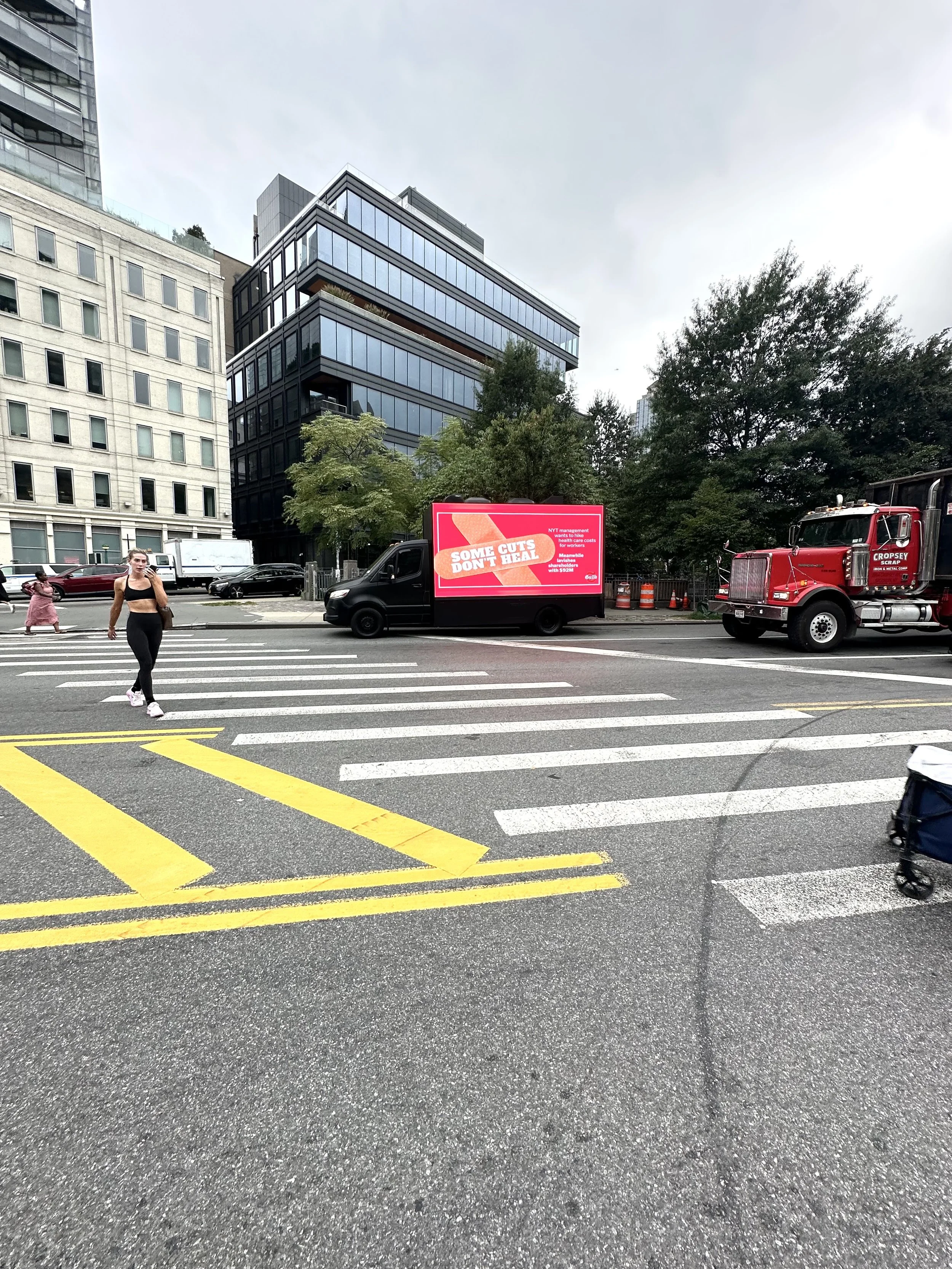
Execution A: one accusation, one photograph, two short statistics. Readable in under three seconds from a stopped car.

Execution B: a slogan built for repetition — four words, oversized, with the supporting argument set in a right-hand column for viewers with longer dwell time.
Why this corridor works
The blocks around Varick, Hudson Street, Laight, Vestry, Beach, Watts, Ericsson Place and West Broadway are one of the most efficient advertising environments in New York, and most media buyers underrate them. Four things stack up within a few hundred yards:
- Holland Tunnel queueing. Traffic backs up on the Canal Street and Varick Street approaches for most of the business day. Stopped vehicles are the highest-value impression in out-of-home — the driver has nothing to do but read your panel.
- A dense white-collar daytime population. Hudson Square went from printing district to media and tech corridor. The lunchtime foot traffic on Hudson, Varick and West Broadway skews precisely toward professional, high-income audiences.
- Sidewalk dwell. Narrow blocks, café seating and constant construction-driven pedestrian bottlenecks mean people spend real seconds standing beside a parked panel.
- Institutional proximity. When a campaign targets a specific organization, running the truck through its own neighborhood puts the message in front of the exact employees, executives, delivery drivers and reporters you want reached — and produces photographs that travel far beyond the route.
That last point is the multiplier no rate card prices. This campaign's 8-hour route logged roughly 65,000 street-level impressions; photographs of the truck, shared onward socially and picked up in coverage, extended reach well past that. A mobile billboard is a media object as well as a media buy.

High-contrast red and white was chosen for daylight legibility; the same palette holds up under the truck's night lighting.
4. The best mobile billboard routes in New York
The right route is built around where your audience stands still, not where the most cars drive. These are the corridors we schedule most often and what each is genuinely good for.
Midtown core
Sixth and Seventh Avenues from 34th to 59th, the Times Square perimeter, and the blocks around Penn Station and Port Authority. Highest raw impression volume in the city — routes here reach the top of the 65,000 range and beyond. Best for consumer brand launches, entertainment, retail and anything needing mass reach. Average speed is the slowest in the city, which is a feature, not a bug.
Hudson Square, Tribeca and Lower Manhattan
Varick, Hudson, Canal, West Broadway, Church Street and the Holland Tunnel approaches. Best for B2B, corporate accountability, legal, financial services and labor campaigns. Tunnel queueing produces exceptional dwell time per dollar.
Financial District and Wall Street
Broadway, Water Street, Stone Street and the Battery. Best for investor relations, shareholder campaigns, fintech and executive recruiting. Weekday lunch hours are the whole game.
Downtown Brooklyn and Williamsburg
Flatbush Avenue, Atlantic Avenue, Bedford Avenue, Metropolitan Avenue and the Barclays Center perimeter. Best for direct-to-consumer brands, nightlife, events and younger audiences. Barclays event nights are among the densest dwell opportunities in the five boroughs.
Queens and the Bronx
Roosevelt Avenue, Queens Boulevard, Northern Boulevard, the Grand Concourse and Fordham Road. Best for multicultural campaigns, healthcare enrollment, civic and public-information messaging, and local retail. Fordham Road carries pedestrian volume rivalling Midtown at a fraction of the competitive clutter.
Event and venue targeting
Stadiums, arenas, convention centers, conference hotels and trade-show loading zones. The most efficient impressions available, because everyone walking past is already in the category. Timing the route around load-in, doors and let-out is what separates a strong run from a wasted one — and this is where the 1.5x live-event multiplier applies.
5. What a mobile billboard truck costs in NYC
Mobile billboard trucks in New York are priced hourly, at $150 to $200 per hour depending on timing, route and whether the date falls around a major event. A standard 8-hour day runs approximately $1,200 to $1,500 for a single LED truck. Against roughly 65,000 impressions, that is a CPM of about $18 to $23, and the effective cost falls as the flight lengthens because mobilization and production are fixed costs spread across more days.
New York mobile billboard rate card
| Activation | Hourly rate | Total | Est. impressions | Est. CPM |
|---|---|---|---|---|
| 4-hour half day off-peak, single route | $150/hr | $600 | ≈ 32,000 | ≈ $18.75 |
| 8-hour standard day the most common New York buy | $150–$200/hr | $1,200–$1,500 | ≈ 65,000 | ≈ $18–$23 |
| 8-hour premium day event dates, peak Midtown windows | $200/hr | $1,600 | ≈ 97,500 (1.5x event multiplier) | ≈ $16.40 |
| 12-hour extended day day into evening, lit panels | $150–$200/hr | $1,800–$2,400 | ≈ 95,000 | ≈ $19–$25 |
| 5-day week, one truck | volume rate | quoted below day rate | ≈ 325,000 | lowest per impression |
| Multi-truck convoy simultaneous borough coverage | volume rate | per truck, quoted | scales near-linearly | fastest route to frequency |
Note the premium-day line: an event route costs more per hour but often delivers the lowest cost per impression on the card, because crowd dwell time works in your favor. If your campaign can be scheduled around a game, a convention or a major public moment, it should be.
What moves your rate
| What moves the price | Effect on your rate |
|---|---|
| Truck type — LED digital vs. printed static | LED carries a premium for hardware and power and earns it when you need motion or multiple messages. Static is better value on flights of two weeks or more. |
| Activation length | Billing is hourly, so you buy exactly the window you need. Eight hours is the standard day. Longer runs improve cost per impression; four-hour minimums are available for tightly targeted activations. |
| Timing within the day | This is the main driver of where you land between $150 and $200. Peak Manhattan windows — roughly 11am to 7pm — price at the top of the range because that is when delivery is highest. Early-morning and off-peak routes price at the bottom. |
| Number of trucks | Multi-truck convoys and simultaneous borough coverage scale impressions close to linearly and are the fastest way to buy frequency. Volume pricing applies. |
| Flight length | Multi-day and multi-week campaigns are quoted below the single-day rate. Vinyl production on static trucks is a one-time cost regardless of flight length. |
| Market | New York City prices above most markets on operating cost alone — parking, fuel, tolls and driver time are all higher here. |
| Premium event dates | Fashion Week, the UN General Assembly, major conventions, holiday retail and election season price higher and book out weeks in advance. |
Put that in context. A four-week static billboard buy in Manhattan typically requires a four-figure weekly commitment with a month minimum and no ability to change the message. One truck day is $1,400, books in days, reaches roughly 65,000 people, and can be pointed at a specific building. For campaigns tied to a moment — a launch, a hearing, a game, a vote — that flexibility is the entire value.
We quote against your actual route and flight rather than a generic rate card. Send us your dates and target blocks and you'll get a route plan and an impression projection before you commit.
6. Mobile billboards vs. static billboards vs. transit ads
| Mobile billboard truck | Static billboard | Subway / bus ads | |
|---|---|---|---|
| Targeting | Street-level, block by block, hour by hour | Fixed to one location permanently | Fixed to a line or station |
| Lead time | Days | Weeks to months; prime inventory often sold out | Weeks |
| Minimum buy | One day, from $1,400 | Typically four weeks | Typically four weeks |
| Change the message? | Yes — instantly on LED | Reprint and reinstall | Reprint and reinstall |
| Proof of delivery | GPS-verified route report with timestamped photos | Posting photo | Posting affidavit |
| Best for | Precision, speed, events, pressure campaigns | Long-term brand presence | Sustained commuter frequency |
These are not mutually exclusive. The strongest New York campaigns we run pair a long-flight static board for baseline presence with truck days scheduled around the moments that matter.
7. How to design creative that works at 25 mph
The most common reason a mobile billboard campaign underperforms is creative built for a screen instead of for a street. Look again at the two executions above and notice what they do not contain: no paragraph, no URL in small type, no five-color gradient, no logo lockup competing with the headline.
The rules we hold clients to
- Seven words or fewer in the headline. "What Matters More?" is three. "Union Made = Human Made" is four. Your driver-side viewer has roughly two seconds.
- One idea per panel. Two arguments means two creatives in rotation, not two stacked on one panel.
- Maximum contrast. White on saturated red, black on yellow, white on black. Mid-tone on mid-tone disappears in daylight glare.
- Headline type at least eight inches tall on a ten-foot panel, with clear margin from the frame.
- A second tier of copy is fine — for stopped viewers. The right-hand statistic columns in both executions exist for the person sitting in tunnel traffic, not the person walking past.
- One call to action, memorable rather than precise. A short brand name or a five-character shortlink beats a full URL every time.
- Design for night. Check colors under the truck's lighting before you print — reds and deep blues shift.
Creative built to these rules is included in our production process; if you're supplying your own artwork, we'll flag anything that won't read at speed before it goes to print or to screen.

Oversized type, a single focal image and a hard color break — the whole panel resolves before a car clears the intersection.
8. NYC rules, permits and what's actually legal
Mobile billboard advertising is legal in New York City, but it is regulated, and the details are where inexperienced operators get campaigns shut down. The practical realities:
- Standard traffic and parking rules apply with no advertising exemption. Standing zones, loading zones, bus lanes and bike lanes are enforced against advertising trucks exactly as against any commercial vehicle. A truck collecting violations is a truck not on route.
- Idling limits are enforced, including through citizen complaints. Our trucks power panel lighting and LED screens from auxiliary systems rather than idling the engine. Ask any vendor how they power their display before you book — this is the single most common way a New York campaign gets interrupted.
- Amplified sound is separately regulated and restricted by time and location. Most campaigns perform better visual-only.
- Some zones restrict commercial vehicle advertising. This is a block-by-block question, not a citywide yes or no, and it has to be resolved during route planning rather than discovered on the day.
- Commercial insurance and DOT compliance are non-negotiable. Ask for certificates. An improperly covered truck is a liability you inherit as the advertiser.
Route compliance is part of what you are buying. We plan every New York route against current restrictions before the truck leaves the yard, and adjust live when construction, street closures or parades reshape the map — which in this city is most weeks.
9. How to measure and report a campaign
Every campaign we run comes back with a GPS-verified proof-of-performance report. If a vendor cannot produce one, you have no way to know the truck ever ran your route. A real report contains:
- The full route trace with timestamps, plotted on a map, showing exactly where the truck traveled and where it dwelled.
- Total route hours and district coverage, so you can confirm you received the eight hours you paid for and the neighborhoods you asked for.
- Timestamped, geotagged photographs of the truck on route, including any specific locations you asked to be covered.
- Hourly delivery, so you can see how impressions accumulated across the day and adjust timing on the next flight.
- The impression total with its gross-versus-unique split, and the live-event multiplier identified where it was applied.
On multi-day campaigns we publish a single shared proof-of-performance link that updates in place as each day's data comes in, so your team and your client see delivery while the campaign is still running rather than a week after it ends.
Add your own measurement layer on top. A campaign-specific landing page, a vanity shortlink, a discount code, or a geofenced retargeting audience built around the route all connect street-level exposure to downstream behavior. Mobile billboards are often called unmeasurable. They aren't — they're usually just measured lazily.

Proof of performance: timestamped route photography is included in every Mobile Billboard Global campaign report.
10. How to book a New York truck in five steps
- Define the audience and the target blocks. Tell us who you need to reach and, if it matters, which building, venue or neighborhood. This drives everything else.
- Pick your dates and hours. Eight hours is standard. Choose the window when your audience is actually on the street — for most Manhattan campaigns that is 10am to 7pm, not 7am to 3pm.
- Approve the route plan and impression projection. You'll see the corridors, the dwell points and the projected delivery before anything is booked.
- Supply or commission creative. LED content can be delivered days before launch; printed vinyl needs production lead time.
- Run, then read the report. The truck runs the approved route and you receive the GPS-verified proof-of-performance report with photography.
Ready to put your message on the street in New York?
Single LED truck, 8-hour route, from $1,400 per day. Tell us your audience, your dates and your target blocks — we'll build the route and show you the impression math before you commit.
11. Frequently asked questions
How many impressions does a mobile billboard truck get in New York?
Approximately 65,000 gross impressions per 8-hour route on a standard Manhattan loop, representing 38,000–44,000 unique viewers at roughly 1.5x frequency. Dense Midtown routes and event-targeted runs exceed this; outer-borough industrial routes fall below it.
How much does a mobile billboard truck cost in NYC?
From $1,400 per day for a single LED billboard truck on an 8-hour activation — a CPM of about $21.50. Rates move with activation length, number of trucks, flight length and whether the date is a premium event day. Multi-day and multi-truck campaigns are quoted below the single-day rate.
How quickly can a campaign launch?
With approved creative, a New York truck can be on route within days. LED campaigns launch fastest because there is no printing step; static vinyl trucks need production lead time.
Can the truck target a specific building or address?
Yes. Targeting a specific headquarters, venue, courthouse or convention center is one of the most common uses of the format. We build the route so the truck passes and dwells nearby at the hours your audience is arriving, leaving or at lunch.
Do mobile billboards work for small businesses?
Very well, on short flights. A single $1,400 day routed tightly around your trade area — your neighborhood, your competitors' blocks, the nearest transit hub — puts a grand opening or a promotion in front of people who can actually walk in. It is one of the few large-format options with a one-day minimum.
What's the difference between a mobile billboard and an LED truck?
"Mobile billboard" is the category; an LED truck is one type within it. Static mobile billboards display one fixed printed message. LED trucks display full-motion digital content that can change by the minute. Both run the same routes and generate comparable impression volume.
Is mobile billboard advertising legal in New York City?
Yes, subject to standard traffic and parking regulations, anti-idling enforcement, sound permitting where audio is used, and location-specific restrictions on commercial vehicle advertising. Compliant route planning is part of every campaign we run.
Do you operate outside New York?
Yes. Mobile Billboard Global operates nationwide from our Atlanta headquarters, with regional fleets including South Florida and the Mid-Atlantic, and we run multi-market campaigns simultaneously across markets.
Keep reading
Mobile Billboard Global operates mobile billboard trucks and LED advertising vehicles in New York City and nationwide. Impression figures reflect GPS-logged route data combined with published municipal traffic counts and are provided as estimates for media planning. Pricing shown is a starting rate as of September 2026 and varies by route, duration and date.