New York City Billboards: Mobile LED Billboard Trucks That Move
Put your message on a digital LED billboard truck in New York City. We route trucks through Midtown, Lower Manhattan, SoHo and Brooklyn, and around the city's arenas, stadiums and Javits Center. Pricing runs about $150–$200 per hour, or $1,200–$1,500 for an 8-hour day, and you get your quote the same day.
- $150–$200/hr
- 8-hour day, driver included
- $0 production
- Proof of performance report
- Same-day quote

New York City Billboards: Mobile LED Billboard Trucks vs. Roadside Boards
Buyers looking at New York billboards quickly learn that Times Square and Midtown screens are some of the most expensive ad space in the world, sold in long-term or share-of-loop deals. An LED billboard truck gives a brand a full-screen, full-motion presence in Manhattan and Brooklyn by the day. It can run SoHo at lunch, Midtown at rush hour and Madison Square Garden at night, and it can follow the city's calendar, from Fashion Week to UN General Assembly week to the Marathon.
How Much Is a Billboard in New York City?
| Format in New York City | How it's sold | Typical cost |
|---|---|---|
| LED billboard truck (Mobile Billboard Global) | Per 8-hour day, 100% of the screen, driver included | From $1,300/day, $0 production |
| XXL jumbotron truck (10 × 22 ft) | Per day | $2,500/day |
| Parked LED screen for events | About 6 hours, operator included | From about $2,000 |
| Static roadside bulletin | Per 4 weeks, plus printing and install | About $1,500–$30,000 nationally* |
| Digital roadside billboard | Per 4 weeks, shared 6–8 ad loop | About $3,500–$25,000 nationally* |
*National ranges from AdQuick rate data; New York City boards vary by corridor. Truck prices are our published rates. Full breakdown: billboard cost guide.
A single Times Square screen spot can cost more for a week than a full month of truck days. Many brands use trucks to own the streets around a launch, a pop-up or an event, and to reach neighborhoods that fixed media does not cover.
Outdoor Advertising in New York City: Where the Crowds Are
Times Square and Midtown
Times Square, Herald Square, Bryant Park and the Fifth Avenue flagship corridor carry some of the densest foot traffic on earth. Trucks drive the Midtown grid and stage where rules allow, timed to theater breaks and rush hours.
SoHo, NoHo and the Lower East Side
Broadway and Prince Street in SoHo, the Bowery and the Lower East Side are the city's fashion, sneaker and pop-up retail hub, ideal for streetwear, beauty and product launches.
Financial District and Hudson Yards
Wall Street, the World Trade Center campus, Brookfield Place and Hudson Yards reach finance and corporate audiences, which makes them strong zones for B2B, fintech and recruiting campaigns.
Madison Square Garden and Penn Station
MSG hosts the Knicks, Rangers, concerts and boxing, and Penn Station moves commuters all day. Event nights put tens of thousands of people on the surrounding blocks.
Brooklyn: Williamsburg, DUMBO and Barclays Center
Williamsburg's Bedford Avenue, DUMBO's waterfront and Barclays Center for Nets and Liberty games and concerts reach young, trend-setting audiences.
Yankee Stadium, Citi Field and the outer boroughs
Yankees and Mets game days, Flushing, the Bronx Hub and Jamaica reach huge local audiences, and bilingual creative performs well across the boroughs.
Midtown East and the UN
UN General Assembly week each September brings world leaders, delegations and international media to Midtown East, one of the most strategic windows for advocacy and policy campaigns. See our UNGA Week page.
New York City Event Calendar for Billboard Trucks
| When | Event or season | Where |
|---|---|---|
| February and September | New York Fashion Week | Manhattan |
| September | UN General Assembly week | Midtown East |
| Early November | New York City Marathon | Five boroughs |
| Year-round | Javits Center trade shows | Hudson Yards, Midtown West |
| Fall–Spring | Knicks, Rangers, Nets and Liberty games | MSG, Barclays Center |
| Spring–Fall | Yankees and Mets home games | The Bronx, Queens |
Sample New York City Billboard Truck Route (8 Hours)
| Hours | Stop | Audience |
|---|---|---|
| 1–2 | Financial District and Brookfield Place | Finance and office workers |
| 3 | SoHo and the Lower East Side | Shoppers, creatives |
| 4–5 | Union Square, Flatiron and Herald Square | Shoppers, commuters |
| 6–7 | Times Square and the theater district | Tourists, theatergoers |
| 8 | Madison Square Garden on event night | Fans |
Digital Billboards in New York City: Truck vs. Roadside
| LED billboard truck | Digital roadside billboard | |
|---|---|---|
| Location | Goes to your audience, any street or venue | Fixed to one road |
| Share of screen | 100% of airtime is yours | One spot in a rotating loop |
| Video and sound | Full-motion video with sound | Short still or animated spots, no sound |
| Minimum buy | One day | Usually 4 weeks |
| Reporting | Proof of performance report with photos and route log | Estimated impressions |
How a New York City Billboard Truck Campaign Works
- Send your goal, dates and ZIP codes. Tell us who you need to reach in New York City and when.
- Get a route and a firm price. We map the neighborhoods, venues and parking spots that match your audience, usually the same day.
- Approve your creative. Send video or images, or let our design team build them. Every file is checked before it runs.
- Run the campaign. A professional driver runs the route with three HD screens and sound, adjusting for traffic and event timing.
- Get your proof of performance report. Photos, video clips, the route log and impression estimates for every day.
Times Square Billboard vs. a Billboard Truck
A Times Square screen gives you one location with a share of a rotating loop. A billboard truck gives you 100% of three screens with sound and the ability to move between Times Square, SoHo, the Financial District and Brooklyn in one day. Many brands combine both: a fixed screen for prestige and a truck to carry the same creative into the neighborhoods where their audience actually lives and shops.
Who Advertises With Billboard Trucks in New York City
- Fashion, beauty and streetwear brands during Fashion Week and product drops.
- Album, film and streaming launches across Manhattan and Brooklyn.
- Advocacy groups and nonprofits during UNGA week.
- Fintech, B2B and recruiting campaigns in the Financial District and Hudson Yards.
- Restaurants, retail openings and pop-up shops.
New York Mobile Billboard Guide: Impressions, Case Study, Creative and Rules
This guide explains how New York truck impressions are calculated, shows a real Manhattan campaign, and covers the creative and permit rules that matter in NYC.
How 65,000 impressions in 8 hours is calculated
A New York route averages roughly 8,000 impressions per hour, and an 8-hour day lands at approximately 65,000. Here is the arithmetic, because you should never accept an impression number a vendor won't show their work on.
An impression in out-of-home is a likely-to-see exposure — a person positioned to view the panel. We build the estimate from three separate streams, then de-duplicate.
| Input | Typical Manhattan value | 8-hour contribution |
|---|---|---|
| Vehicle traffic passing the truck (DOT annual average daily traffic on the corridors run, converted to hourly) | 1,100–1,900 vehicles/hour adjacent | ≈ 28,000–34,000 |
| Occupancy multiplier (drivers plus passengers) | 1.35 persons per vehicle | applied to the row above |
| Pedestrian exposure at dwell points and signal stops | 2,000–3,500/hour in Midtown and Lower Manhattan | ≈ 22,000–28,000 |
| Transit-adjacent viewers (bus riders, subway entrances, plazas) | varies by stop | ≈ 6,000–9,000 |
| De-duplicated 8-hour total | ≈ 65,000 |
Why we de-duplicate: a truck looping the same eight blocks will pass the same office worker three times. That is three exposures, not three people. We report both — gross impressions (total exposures, the number most vendors quote) and estimated unique reach (people, the number that matters for planning frequency). A tight downtown loop typically produces about 65,000 gross impressions against 38,000–44,000 unique viewers, an average frequency of roughly 1.5x.
The live-event multiplier
Routes built around a stadium, arena or convention center behave differently from a commuter loop, so we apply a 1.5x multiplier to modeled totals on live-event activations. The reason is dwell: crowds arriving and leaving a venue move slowly, cluster at entrances and crosswalks, and spend far longer beside a stationary panel than a pedestrian mid-block. We ran a four-day stadium campaign across Cincinnati and Cleveland in September 2026 — an NFL home opener followed by three days at an MLB series — and the event-day delivery consistently outran the equivalent commercial-district route.
Two levers move the base number hard in either direction. The first is route density: a Midtown loop between 11am and 7pm will outperform an outer-borough industrial route by a factor of three. The second is dwell strategy: legal parked time in a high-footfall zone converts far more pedestrians than continuous driving, because a stationary panel gives people two to fifteen seconds of read time instead of a second and a half.
Case study: a labor campaign in Hudson Square
One of the clearest demonstrations of what a New York route can do came from a union communications campaign through Hudson Square and Tribeca — the wedge of Lower Manhattan where Varick Street carries traffic down to the Holland Tunnel at Canal Street.
The creative was blunt, high-contrast and built for a moving panel. Two executions rotated on the truck.
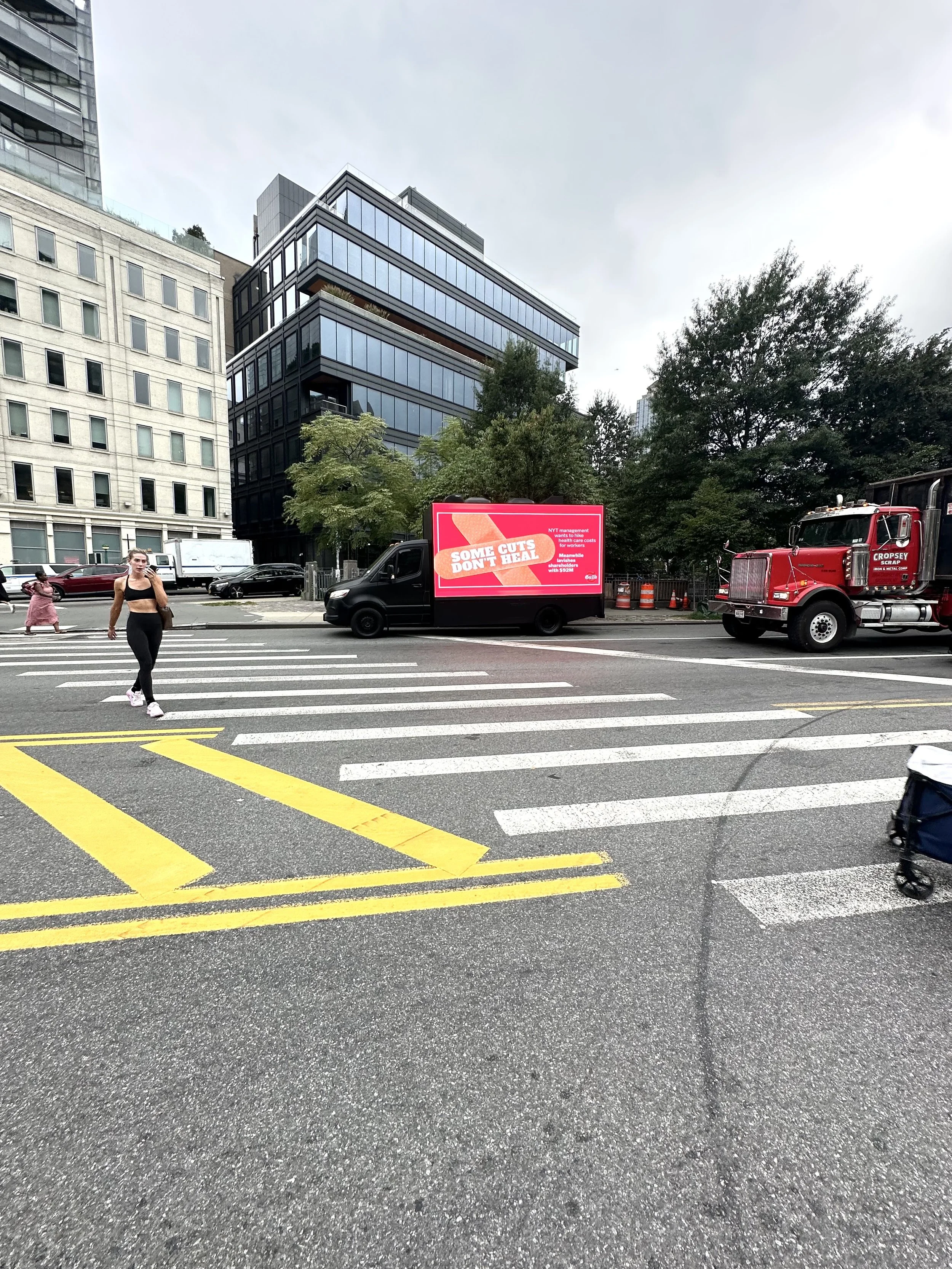
Execution A: one accusation, one photograph, two short statistics. Readable in under three seconds from a stopped car.

Execution B: a slogan built for repetition — four words, oversized, with the supporting argument set in a right-hand column for viewers with longer dwell time.
Why this corridor works
The blocks around Varick, Hudson Street, Laight, Vestry, Beach, Watts, Ericsson Place and West Broadway are one of the most efficient advertising environments in New York, and most media buyers underrate them. Four things stack up within a few hundred yards:
- Holland Tunnel queueing. Traffic backs up on the Canal Street and Varick Street approaches for most of the business day. Stopped vehicles are the highest-value impression in out-of-home — the driver has nothing to do but read your panel.
- A dense white-collar daytime population. Hudson Square went from printing district to media and tech corridor. The lunchtime foot traffic on Hudson, Varick and West Broadway skews precisely toward professional, high-income audiences.
- Sidewalk dwell. Narrow blocks, café seating and constant construction-driven pedestrian bottlenecks mean people spend real seconds standing beside a parked panel.
- Institutional proximity. When a campaign targets a specific organization, running the truck through its own neighborhood puts the message in front of the exact employees, executives, delivery drivers and reporters you want reached — and produces photographs that travel far beyond the route.
That last point is the multiplier no rate card prices. This campaign's 8-hour route logged roughly 65,000 street-level impressions; photographs of the truck, shared onward socially and picked up in coverage, extended reach well past that. A mobile billboard is a media object as well as a media buy.

High-contrast red and white was chosen for daylight legibility; the same palette holds up under the truck's night lighting.
How to design creative that works at 25 mph
The most common reason a mobile billboard campaign underperforms is creative built for a screen instead of for a street. Look again at the two executions above and notice what they do not contain: no paragraph, no URL in small type, no five-color gradient, no logo lockup competing with the headline.
The rules we hold clients to
- Seven words or fewer in the headline. "What Matters More?" is three. "Union Made = Human Made" is four. Your driver-side viewer has roughly two seconds.
- One idea per panel. Two arguments means two creatives in rotation, not two stacked on one panel.
- Maximum contrast. White on saturated red, black on yellow, white on black. Mid-tone on mid-tone disappears in daylight glare.
- Headline type at least eight inches tall on a ten-foot panel, with clear margin from the frame.
- A second tier of copy is fine — for stopped viewers. The right-hand statistic columns in both executions exist for the person sitting in tunnel traffic, not the person walking past.
- One call to action, memorable rather than precise. A short brand name or a five-character shortlink beats a full URL every time.
- Design for night. Check colors under the truck's lighting before you print — reds and deep blues shift.
Creative built to these rules is included in our production process; if you're supplying your own artwork, we'll flag anything that won't read at speed before it goes to print or to screen.

Oversized type, a single focal image and a hard color break — the whole panel resolves before a car clears the intersection.
NYC rules, permits and what's actually legal
Mobile billboard advertising is legal in New York City, but it is regulated, and the details are where inexperienced operators get campaigns shut down. The practical realities:
- Standard traffic and parking rules apply with no advertising exemption. Standing zones, loading zones, bus lanes and bike lanes are enforced against advertising trucks exactly as against any commercial vehicle. A truck collecting violations is a truck not on route.
- Idling limits are enforced, including through citizen complaints. Our trucks power panel lighting and LED screens from auxiliary systems rather than idling the engine. Ask any vendor how they power their display before you book — this is the single most common way a New York campaign gets interrupted.
- Amplified sound is separately regulated and restricted by time and location. Most campaigns perform better visual-only.
- Some zones restrict commercial vehicle advertising. This is a block-by-block question, not a citywide yes or no, and it has to be resolved during route planning rather than discovered on the day.
- Commercial insurance and DOT compliance are non-negotiable. Ask for certificates. An improperly covered truck is a liability you inherit as the advertiser.
Route compliance is part of what you are buying. We plan every New York route against current restrictions before the truck leaves the yard, and adjust live when construction, street closures or parades reshape the map — which in this city is most weeks.
How to measure and report a campaign
Every campaign we run comes back with a proof-of-performance report. If a vendor cannot produce one, you have no way to know the truck ever ran your route. A real report contains:
- The full route trace with timestamps, plotted on a map, showing exactly where the truck traveled and where it dwelled.
- Total route hours and district coverage, so you can confirm you received the eight hours you paid for and the neighborhoods you asked for.
- Timestamped, geotagged photographs of the truck on route, including any specific locations you asked to be covered.
- Hourly delivery, so you can see how impressions accumulated across the day and adjust timing on the next flight.
- The impression total with its gross-versus-unique split, and the live-event multiplier identified where it was applied.
On multi-day campaigns we publish a single shared proof-of-performance link that updates in place as each day's data comes in, so your team and your client see delivery while the campaign is still running rather than a week after it ends.
Add your own measurement layer on top. A campaign-specific landing page, a vanity shortlink, a discount code, or a geofenced retargeting audience built around the route all connect street-level exposure to downstream behavior. Mobile billboards are often called unmeasurable. They aren't — they're usually just measured lazily.

Proof of performance: timestamped route photography is included in every Mobile Billboard Global campaign report.
New York City Billboard FAQ
How much is a billboard in New York City?
Roadside billboards in New York City are sold by the 4-week period and vary by corridor, with printing and installation extra on static faces. A Mobile Billboard Global LED billboard truck starts at $1,300 per 8-hour day with driver, route, sound and proof of performance included and $0 production.
Are mobile billboards legal in New York City?
Yes. LED billboard trucks drive public roads under normal traffic law. Some districts limit parking, idling or event-day access, and we plan the route around those rules. See mobile billboard laws by city.
How far ahead should I book a billboard truck in New York City?
A few days is often enough for a regular weekday. Book 4 to 8 weeks ahead for major events and holiday weekends.
What files do I need?
Video (MP4) or still images (JPG/PNG). Our design team checks every file before it runs, and we can build the creative for you.
Can a billboard truck park in Times Square?
Trucks can drive through Times Square and the Midtown grid. Stopping and parking are restricted in many Manhattan locations, so we plan legal staging points and keep the truck moving where required.
More: New York State billboards · New Jersey · UNGA Week · mobile billboard near me · LED billboard trucks · billboard truck rental · LED screen rental
Where Our Mobile Billboard Trucks Drive in New York City
We build each New York City route around the people you want to reach. These are the areas brands book most often, and every route is custom.
Midtown & Times Square
The densest foot traffic in the country: commuters, tourists and theater crowds.
Financial District
Finance and professional-services audiences in Lower Manhattan.
SoHo & the Village
Shoppers, students and fashion and retail audiences.
Hudson Yards & Javits Center
Trade show and convention attendees on the West Side.
Brooklyn (Williamsburg & DUMBO)
Young professionals and Barclays Center crowds.
Harlem & the Bronx
Community audiences and Yankee Stadium game-day traffic.
We also cover all five boroughs, Long Island, Westchester and northern New Jersey.
Suggested Mobile Billboard Routes in New York City
These are three starting routes for New York City, built around commute hours, the Midtown evening rush and weekend shopping. We adjust every route to your audience, date and local rules before the campaign.
Midtown & Times Square evening
Path: 7th Ave and Broadway through Times Square, 42nd St to Bryant Park, then 6th Ave north toward Rockefeller Center.
Best time: Weekdays, 5 to 9 pm.
Who sees it: Commuters, tourists and theater crowds in the densest foot traffic in the country.
Lower Manhattan workday
Path: Broadway and Church St through the Financial District, around the Fulton Center, then West St past Brookfield Place.
Best time: Weekdays, 7 to 10 am and 11:30 am to 2 pm.
Who sees it: Finance, law and professional-services audiences.
SoHo to Williamsburg weekend
Path: Broadway, Prince St and Spring St in SoHo, then over the Williamsburg Bridge to Bedford Ave and Wythe Ave.
Best time: Saturday and Sunday, noon to 7 pm.
Who sees it: Shoppers, young professionals and weekend crowds.
Route tip: in Manhattan, trucks move slowly, and that works in your favor. A tight loop of a few blocks at rush hour puts your ad in front of the same crowd again and again.
New York City Venues and Events to Target
The strongest days for a mobile billboard in New York City are the days crowds are already there. We cover Madison Square Garden, Barclays Center, the Javits Center, Yankee Stadium, Citi Field and the UN headquarters area.
UNGA week
Every September, world leaders, NGOs and media fill Midtown East. See our UNGA week mobile billboard page.
New York Fashion Week
February and September runway weeks bring fashion, beauty and retail press to Manhattan.
US Open & NYC Marathon
Late-summer tennis in Queens and the November marathon through all five boroughs.
Conventions at Javits
Auto, food, tech and fan conventions run at the Javits Center throughout the year.
Planning around a specific event? See the event advertising hub.
How Much Does a Mobile Billboard Cost in New York City?
In New York City, a digital LED billboard truck runs about $150–$200 per hour, depending on timing and events. An 8-hour day runs about $1,200–$1,500, with the driver, route planning and a proof of performance report included.
| Option | Starting price | Best for |
|---|---|---|
| LED billboard truck, hourly | $150–$200/hr | Short activations, launches, events |
| LED billboard truck, full day (8 hrs) | About $1,200–$1,500 | Full-day brand and awareness campaigns |
| Multi-day or multi-truck campaigns | Discounted, quoted per campaign | Product launches, elections, tours |
| Parked LED screen with live streaming | From about $2,000 (~6 hrs) | Watch parties, festivals, activations |
| XXL jumbotron truck (10 ft x 22 ft) | $2,500/day | Stadiums, parades, big-crowd events |
Major event days can carry premium pricing. There is no production cost, because the trucks are fully digital. Full breakdown: 2026 mobile billboard cost guide.
What's Included With Every New York City Truck
Every booking includes the truck, a professional driver, a planned route, sound, ad rotation and a proof of performance report.
Tell us where and when
Send your date and audience: a Midtown launch, a Javits show, a Barclays Center night or all five boroughs.
Approve route and price
We plan the NYC route and send a firm price the same day.
Send your ad, we drive
Send video or image files. Our design team checks them for errors, and files aren't needed until the morning of the campaign.
- Professional driver for the full shift
- Rotate several ads in one booking
- $0 production: no vinyl, printing or install
- Built-in sound system included
- Quiet, custom-built power units, with no rattling generators
- Proof of performance report after the campaign
Mobile Billboard New York City: FAQ
How much does a mobile billboard cost in New York City?
Trucks run about $150 to $200 per hour, or about $1,200 to $1,500 for an 8-hour day, with the driver and proof of performance report included. UNGA week and Fashion Week are premium dates.
Where can a mobile billboard drive in New York City?
We plan routes around your audience. Popular areas include Midtown & Times Square, Financial District, SoHo & the Village and Hudson Yards & Javits Center, plus Madison Square Garden and other big venues. You approve the route before the campaign.
Do you cover the suburbs around New York City?
Yes. We also run routes in all five boroughs, Long Island, Westchester and northern New Jersey.
When should I book a mobile billboard in New York City?
UNGA week in September, Fashion Week and marathon weekend in November book up first, so reserve those dates early. Other dates usually need less lead time. Your artwork isn't needed until the morning of the campaign.
Is a mobile billboard legal in New York City?
Rules for advertising vehicles in New York City are strict, and they cover parking, idling and how trucks operate. We plan every NYC campaign around the current rules and tell you up front what your route can and can't do. Read more in our mobile billboard laws by city guide.
How do I know my ad ran?
Every campaign comes with a proof of performance report showing where and when your ad ran.
Related: UNGA week mobile billboards · Mobile billboards in New York State · Find a mobile billboard near me · LED billboard trucks
Other Cities We Cover
Book a Mobile Billboard Truck in New York City
Send your date and audience and get NYC pricing back the same day.