Mobile Billboard Advertising in Cincinnati
Cincinnati Campaign Data
Mobile Billboard Advertising in Cincinnati: 69,669 Impressions in a Single Game Day
Most mobile billboard advertising quotes come with a number and no receipt. So we tracked a digital billboard truck through a full eight-hour activation in downtown Cincinnati — every street, every neighborhood, every hour — and published the delivery data. Here is exactly what a Cincinnati game day produces.
In this article
- What is a digital billboard truck?
- How many impressions does mobile billboard advertising deliver?
- Every Cincinnati neighborhood and street we covered
- Which Cincinnati districts delivered the most impressions
- When impressions peak on a Cincinnati game day
- Why the Paycor Stadium perimeter outperforms every other route
- How mobile billboard impressions are measured
- Is mobile billboard advertising right for your campaign?
- Frequently asked questions
What is a digital billboard truck?
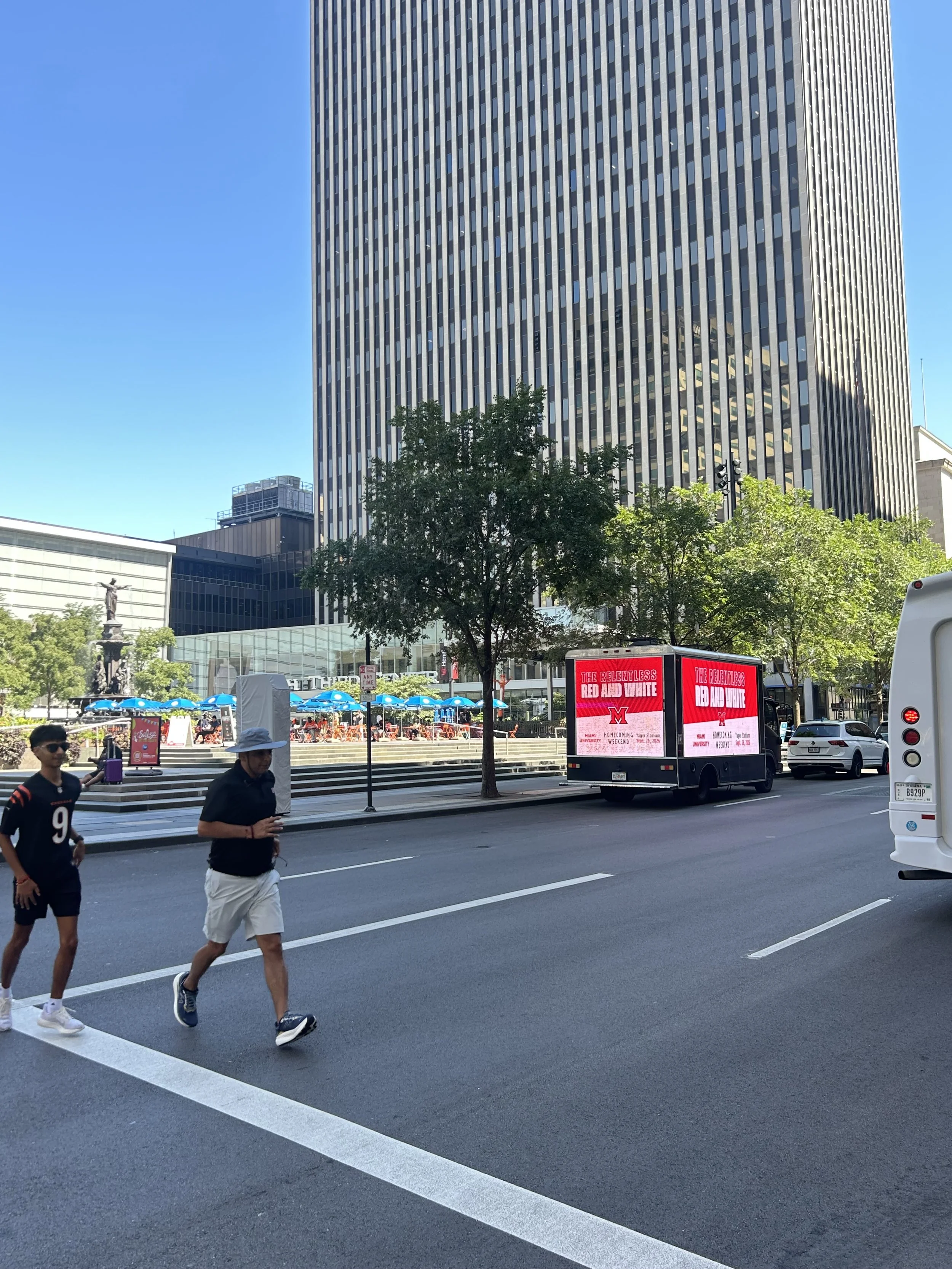
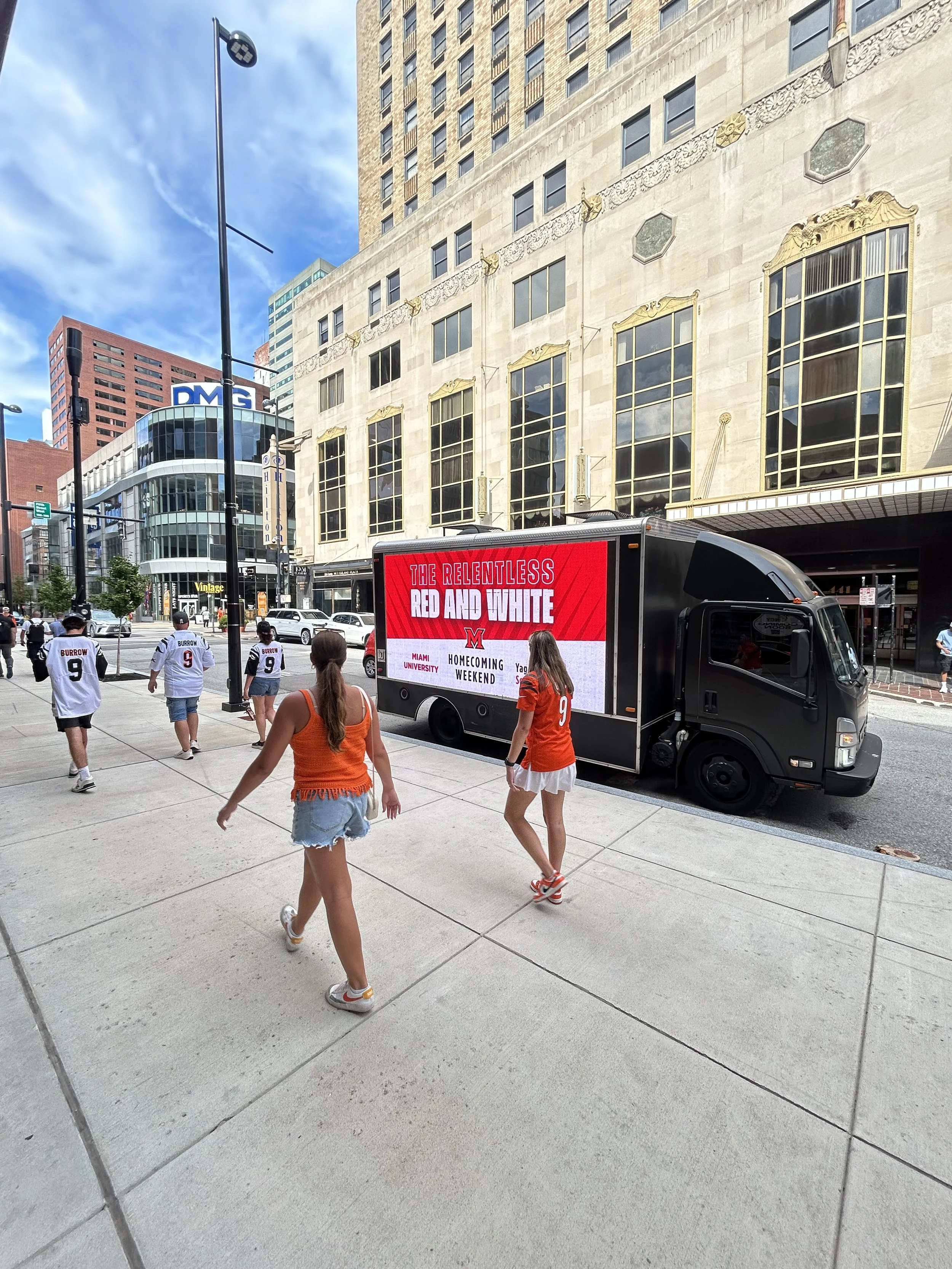
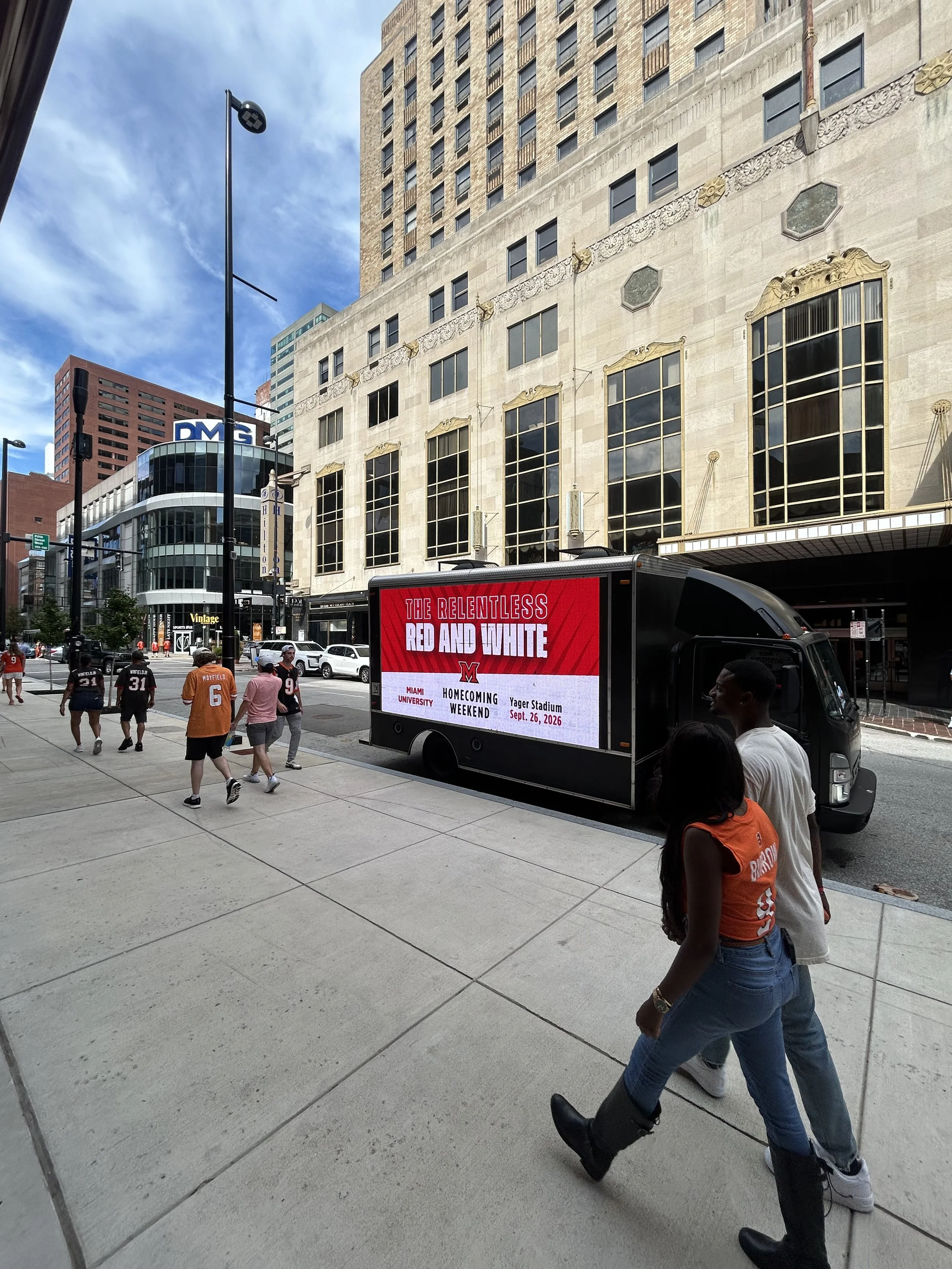
A digital billboard truck is a vehicle carrying large LED screens that drives a planned route through the areas where your audience actually is. Instead of waiting for traffic to pass a fixed sign, the sign goes to the traffic — downtown business districts at lunch, a stadium at kickoff, a festival at closing time.
Mobile billboard advertising is bought by the day or the activation rather than by the four-week cycle a static billboard uses. That makes it a different tool: less about long-run frequency, more about owning a specific place on a specific day. Grand openings, product launches, event marketing, conference takeovers, political campaigns and recruitment drives all fit the format.
The rest of this article is one real Cincinnati activation, reported in full.
How many impressions does mobile billboard advertising deliver in one day?
A digital billboard truck working a major event delivers roughly 65,000–70,000 impressions in a single eight-hour day. Our Cincinnati activation delivered 69,669 across 21 ZIP codes and 171 named streets.
On an ordinary route with no event anchor, expect the lower end of the industry range instead — closer to 30,000–40,000. The event is the multiplier.
That gap is the whole point of mobile billboard advertising. The size of the crowd sets the ceiling, so the route is the product. Park the same digital billboard truck on a quiet suburban arterial in Blue Ash for eight hours and you will not get half these numbers.
Impressions
69,669
One eight-hour activation
Eyes-On
31,351
Conservative count
ZIP Codes
21
Ohio and Kentucky
Streets
171
Named streets covered
Every Cincinnati neighborhood and street we covered
The route touched 21 ZIP codes across Hamilton County, Ohio and Campbell and Kenton Counties, Kentucky in one day. This is the part most vendors will not show you, so here it is in full.
Downtown Cincinnati (45202)
The core of the campaign. The digital billboard truck circulated the central business district grid — Vine Street, Walnut Street, Race Street, Main Street, Elm Street, Sycamore Street and the numbered cross streets from 4th through 9th. Fountain Square, Government Square and the Court Street district all sit inside that grid, and downtown 45202 alone produced 38.3% of the day's impressions.
The Banks and the Cincinnati riverfront
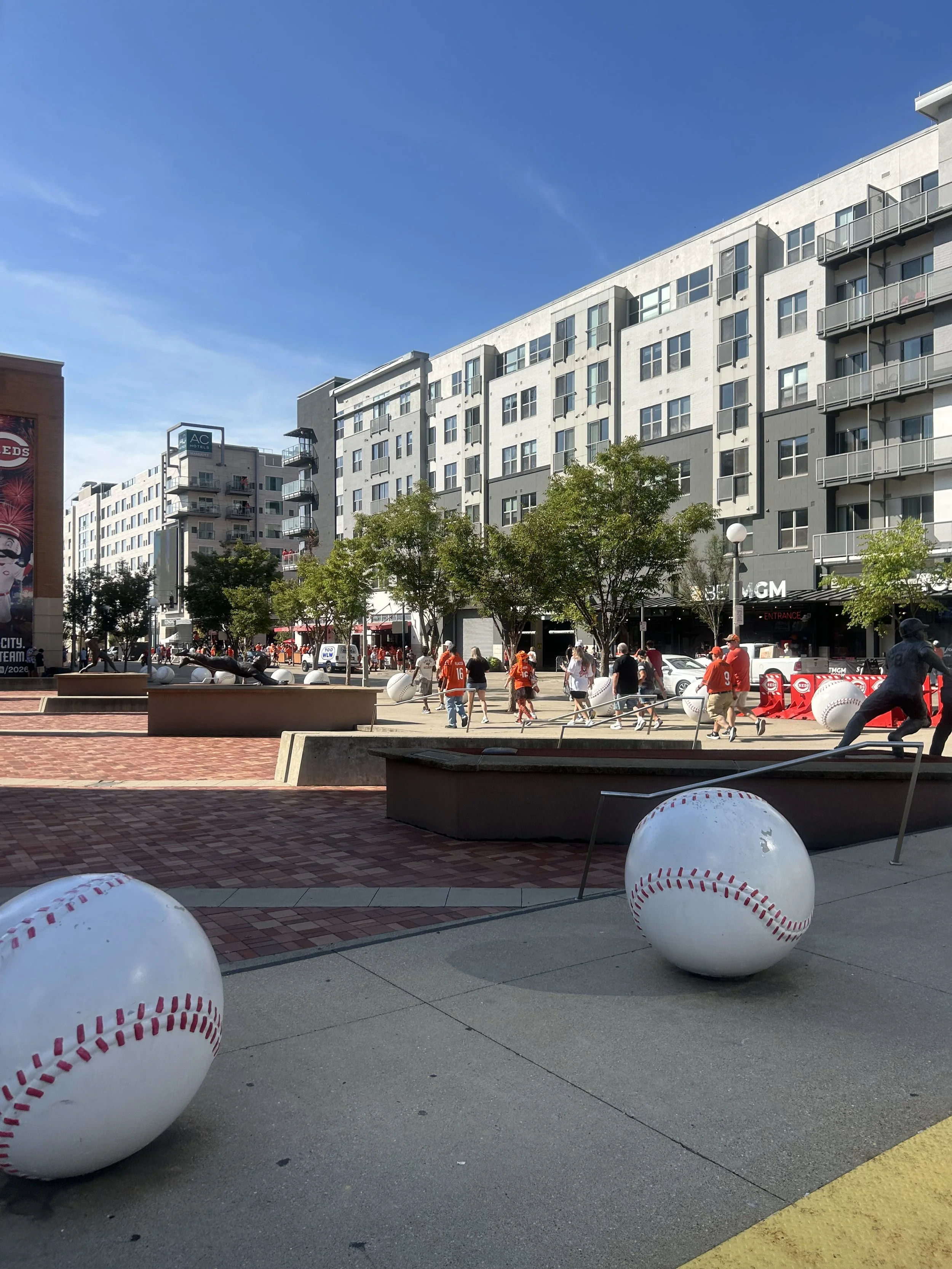
The riverfront entertainment district between the two stadiums. The route worked East and West 2nd Street, 3rd Street, Freedom Way, Joe Nuxhall Way and Pete Rose Way, plus Mehring Way along the Ohio River. The Banks is where pre-game and post-game foot traffic concentrates, and it is the single highest-density stretch on any Cincinnati game day.
Over-the-Rhine and Findlay Market
North of downtown, the truck ran Central Parkway, Liberty Street, Elder Street, Race Street through the market blocks, Vine Street up through OTR, McMicken Avenue and the Odeon Street area. Findlay Market draws more than a million visitors a year and Sunday is its busiest trading day, which made it a strong morning stop before the stadium windows opened.
West End, Queensgate and the stadium approaches
Central Avenue, Ezzard Charles Drive, Linn Street and Gest Street — the corridors carrying parking traffic into the stadium district from the west (45203, 45214, 45225).
I-75, I-71 and Fort Washington Way
The freeway network feeding downtown. Fort Washington Way carries roughly 111,000 vehicles a day through the center of the city, and I-75 and I-71 bring fans in from Northern Kentucky, Sharonville, Springdale and the northern suburbs. Interstate time delivered 23.2% of the campaign.
Newport and Covington, Kentucky
The truck crossed the Ohio River to work the Northern Kentucky riverfront — Newport (41071), Covington (41011), Bellevue (41073) and Dayton, Kentucky (41074) — catching inbound fans before they crossed the bridges into Cincinnati.
Ohio · Hamilton County ZIP codes covered
45202 45203 45206 45208 45214 45215 45216 45217 45219 45220 45223 45225 45229 45232 45237 45241 45246
Cincinnati, Sharonville and Lockland.
Kentucky · Campbell & Kenton Counties
41011 41071 41073 41074
Covington, Newport, Bellevue and Dayton, Kentucky.
Ranked by exposure, these were the fourteen corridors that carried the campaign:
Which Cincinnati districts delivered the most impressions
Three districts produced 86% of the day's total: the downtown Cincinnati core, the Paycor Stadium and riverfront zone, and the interstate approaches carrying fans into the city.
| Cincinnati district | Impressions | Share | |
|---|---|---|---|
| Downtown core Vine, Walnut, Race, Main, 5th & 6th | 26,660 | 38.3% | |
| Stadium & riverfront Paycor perimeter, The Banks, Mehring Way | 17,299 | 24.8% | |
| Interstate approaches I-75, I-71, Fort Washington Way | 16,184 | 23.2% | |
| Over-the-Rhine Findlay Market, Liberty St, Central Pkwy | 2,403 | 3.4% | |
| Uptown connector Reading Rd, Gilbert Ave | 2,248 | 3.2% | |
| Other surface streets | 2,030 | 2.9% | |
| Northern Kentucky riverfront Newport, Covington, Bellevue | 1,491 | 2.1% | |
| West End & Queensgate Central Ave, Ezzard Charles Dr | 1,355 | 1.9% |
Notice the interstate line. Highway miles look unglamorous on a route plan, but Fort Washington Way alone moves more than 100,000 vehicles a day through the middle of Cincinnati. Nearly a quarter of the campaign came from road the digital billboard truck was simply driving along to get somewhere else.
When impressions peak on a Cincinnati game day
Delivery peaked at 13,086 impressions in the 11 AM hour — roughly three times the quietest hour of the day. The two priority windows, fan arrival and post-game departure, returned 47.6% of all impressions from 38% of the time on the clock.
Delivery climbs through the arrival wave on Mehring Way and Pete Rose Way, dips while the crowd is inside the stadium, then lifts again for the exit.
The dip at 3 PM is worth understanding if you are planning a Cincinnati campaign. That is the quietest stretch of any game day: the crowd is seated, downtown is empty, and there is simply less audience on the street. Good routing accepts that trough and spends it repositioning rather than burning fuel on empty roads.
Why the Paycor Stadium perimeter outperforms every other route
Because the audience is dense, slow and on foot. A digital billboard truck moving through game traffic on Mehring Way at 8 mph in a crowd of tailgaters is seen by far more people per minute than the same truck at 45 mph on I-75 — and each of those people looks at it for longer.
Three things stack up in the stadium window:
- Density. A sellout crowd at a 65,515-seat stadium converges on a handful of approach roads inside a two-hour window.
- Dwell. Game traffic on Pete Rose Way and Central Avenue crawls. Stopped and slow-moving time means the ad is in view for seconds, not a fraction of one.
- Mood. People heading to a game are unhurried, social and looking around. That is a better audience than a commuter staring at brake lights on the Brent Spence Bridge.
How mobile billboard impressions are measured
Impressions are modelled, not counted — no out-of-home medium counts individual viewers. What separates a defensible figure from a made-up one is whether the inputs are disclosed. Ours are.
Every position the digital billboard truck occupied is logged by its onboard tracking, timestamped to the second. Each position is matched to a district, and each district carries an audience flow rate: how many people pass through the display's field of view per hour, combining vehicle occupants and pedestrians. Time in a district multiplied by that rate gives the impressions.
The supporting inputs come from public data rather than our own guesswork:
- Vehicle occupancy of 1.5 people per trip, the national average in the Federal Highway Administration's National Household Travel Survey.
- Published traffic counts — Fort Washington Way carries roughly 111,000 vehicles per day through downtown Cincinnati.
- Venue capacity of 65,515 at Paycor Stadium, with a live-event factor applied for a sellout crowd.
We publish two numbers on every campaign: the total impression figure, and a conservative "eyes-on" count that discounts for people who were in range but did not have a clear line of sight. On this Cincinnati activation those were 69,669 and 31,351. Any vendor who gives you one number and no method is asking you to take it on faith.
Is mobile billboard advertising right for your campaign?
It fits when you need a specific audience in a specific place on a specific day. The route matters more than the mileage — delivery here was driven by where the truck was and when, not how far it drove. A few practical lessons from the data:
- Anchor to an event. A stadium, festival, convention at the Duke Energy Center, or a Findlay Market weekend concentrates your audience in a way ordinary traffic never will.
- Buy the windows, not the hours. Arrival and departure are worth several times an average hour. Make sure your route plan protects them.
- Do not dismiss highway time. Getting to the venue on I-75 or Fort Washington Way is billable audience, not dead mileage.
- Ask for the tracking data. If a mobile billboard company cannot show you which streets the truck actually drove, the impression number is decoration.
Frequently asked questions
How many impressions does a mobile billboard get per day?
Industry figures put a mobile billboard at 30,000 to 70,000 impressions per truck per day. The range is wide because it depends almost entirely on route density. A quiet suburban route sits at the bottom; a downtown route anchored to a major event sits at the top. Our tracked Cincinnati game-day activation delivered 69,669 impressions in eight hours across 21 ZIP codes.
How much does mobile billboard advertising cost in Cincinnati?
Pricing is set by the length of the activation, the number of trucks, the market, and whether the date is a premium event day. Game days, festival weekends and convention dates carry a premium because demand for those windows is finite. Contact us with your dates and target area for a route plan and quote.
Where can a digital billboard truck drive in Cincinnati?
Any legal public roadway and approved staging area. That covers the downtown 45202 grid, The Banks, Over-the-Rhine, the West End approaches, the interstates and the Northern Kentucky riverfront. Trucks cannot enter private lots, stadium-controlled property, pedestrian-only zones such as parts of Fountain Square, or restricted event-traffic areas without permission.
Are mobile billboards better than static billboards?
They serve different jobs. A static billboard delivers the same location repeatedly over weeks and builds frequency cheaply. Mobile billboard advertising delivers a chosen audience on a chosen day, which is what you want for an event, launch, grand opening or short campaign window. Many advertisers run both.
How is a mobile billboard impression measured?
By combining the vehicle's tracking log with the audience density of each area it covered. Time spent in a district is multiplied by how many people pass through the display's field of view there per hour. Reputable operators disclose those inputs and report a conservative eyes-on figure alongside the headline number.
How far in advance should I book a Cincinnati game-day campaign?
As early as you can. Bengals home dates, Reds homestands and major festival weekends go first, and route planning around road closures and event traffic control takes lead time. For a marquee date, several weeks out is sensible.
Want mobile billboard advertising in Cincinnati?
We plan the route around your audience — downtown, The Banks, Over-the-Rhine, the stadium district or Northern Kentucky — and report back with the tracking data behind every impression, street by street and hour by hour.
Get a route plan and quoteFigures in this article come from a tracked eight-hour digital billboard truck activation in Cincinnati, Ohio on September 13, 2026. Impressions are modelled from vehicle tracking data together with published traffic and venue figures, and represent exposure opportunity rather than unique reach. Mobile Billboard Global is not affiliated with, endorsed by, or sponsored by any stadium, team or league named in this article.